💡 Advantages of RFM analysis
-
Overview: RFM analysis (recency, frequency, monetary value) provides a clear overview of customer purchasing behavior.
-
Analysis: This enables the identification of valuable customer segments.
-
More efficient strategies: Specific campaigns can be sent based on the segments.
Description of the feature
What can this feature do?
RFM analysis is an analytical function that evaluates customers based on their purchase history. It uses three main criteria: recency, frequency, and monetary value to classify customers into different segments. This segmentation helps to identify the most valuable customers and target them specifically. Based on the segments
campaigns can be created and planned.
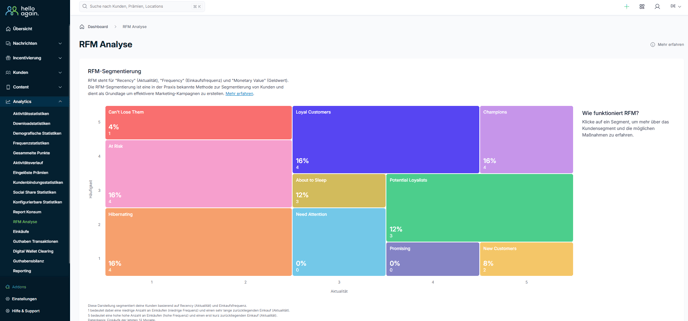
The segments are as follows:
.png?width=688&height=1223&name=rfm-analyse%20(1).png)
-
Can't Lose Them
-
Loyal (Loyal Customers)
-
Champions
-
In hibernation mode
-
Needs attention
-
Potential loyalist
-
At risk
-
About to Sleep
-
Prom ising
-
New Customers
How it works in the dashboard/app
How it works in the app
This analysis is not visible to customers in the app; it is only visible to dashboard managers.
Creation in the dashboard
The RFM analysis can be accessed via the dashboard:
➡️ Navigation: Analytics → RFM analysis
💡 Note: The analysis is available in the Pro Plan. Users on the Starter or Plus Plan will see an upsell page in the dashboard.
Here's how it works:
1️⃣ Automatic segmentation:
Customers are automatically divided into segments such as power users or those at risk of churning.
2️⃣ Graphical representation:
The results are presented in a clear graph that is easy to understand.
3️⃣ Detailed insights:
Clicking on a segment shows you detailed information about the assigned customers.
4️⃣ Campaign planning:
Based on the segments, you can create targeted campaigns for specific customer groups or individual users.
use cases
-
A typical use case is the identification of champions who shop regularly and generate high sales. These customers can be targeted with exclusive offers and personalized messages to further strengthen their loyalty.
-
Another use case is to reactivate customers from the "can't lose them" segment, for example with a return offer.
Technical details and integration
Technical requirements:
- For the RFM analysis The following data must be available in the dashboard:
- Time of purchases
- Frequency of purchases
- Revenue per customer
- Only with this data can the analysis be presented correctly.
Calculation of the RFM analysis:
The analysis divides customers into five groups based on two criteria:
1️⃣ Recency: How recently was the customer active?
2️⃣ Frequency: How often has the customer been active in the last 12 months?
- Evaluation: Recency and frequency are divided into 20% increments.
- Grouping:
- Class 1: The bottom 20% (least active or long inactive).
- Class 5: The top 20% (most active or recently active).
- Grades 2-4: Intermediate customer groups.
💡 Example:
- A customer who has been very active in the last 12 months is classified in the highest frequency class (5).
- A customer who was rarely active ends up in the lowest frequency class (1).
- Recency: Customers who have been active recently are placed in a higher class; inactive customers are placed in a lower class.
5x5 matrix:
The analysis is performed using a 5x5 matrix, which shows:
- How often customers were active (frequency).
- How recently they were active (Recency).
Requirements:
- Sales must be measured (e.g., via RKSV/TSE or cash register integration).
- Multi-client capability is not supported.
With these requirements, RFM analysis delivers precise results for targeting specific customer groups. 🚀
Would you like to work with this feature too? Then just let us know!